
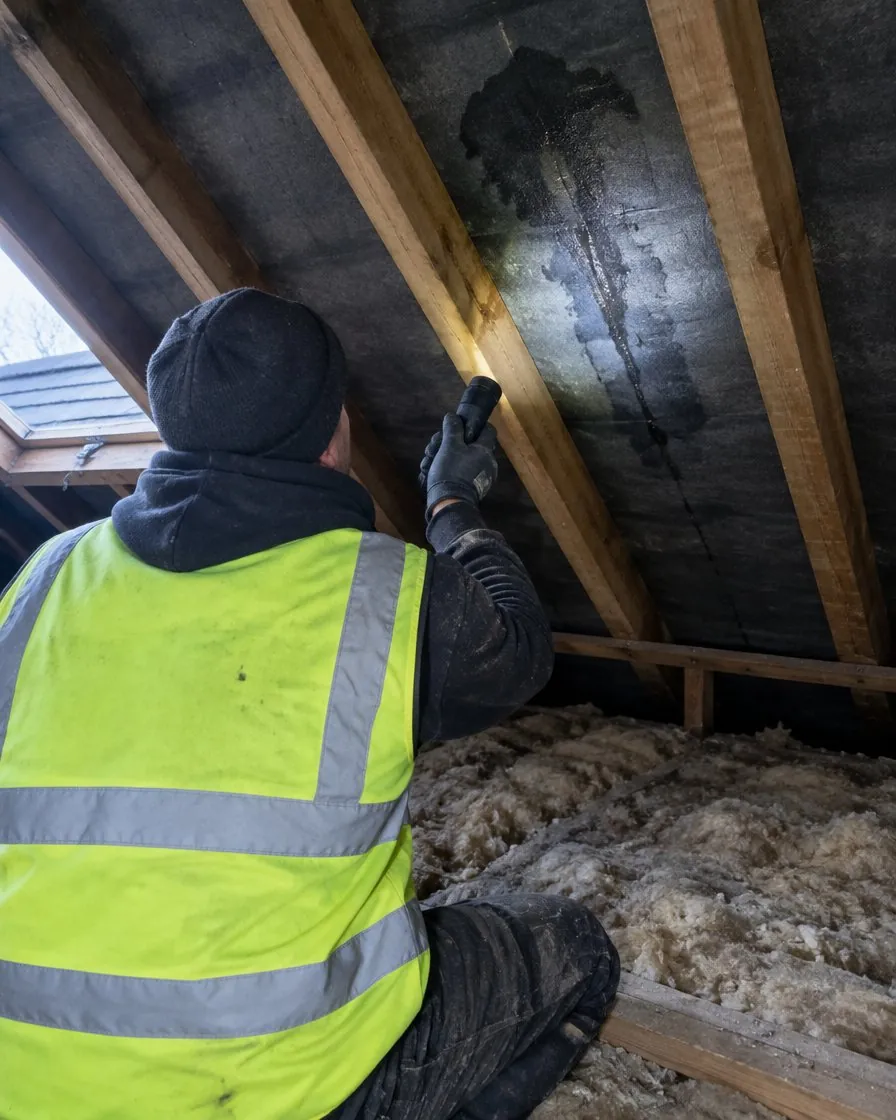
Why Roof Leaks Are Hard to Find
Three things make a roof leak in Crewe harder to find than it looks.
Water Travels
Water entering at the ridge can appear at the eaves two rooms away. It runs down rafters, along the top of the membrane, through the insulation and across the ceiling before it finds a place to drip. The stain tells you where it ended up, not where it started.
Intermittent Problems
Some leaks only show in wind-driven rain from one direction, or only when the gutter is blocked, or only when snow sits on the roof and melts. By the time a roofer arrives on a dry day there's nothing to see.
Hidden Entry Points
A hairline split in a lead flashing, a cracked tile under a layer of moss, a nail hole in a felt roof, a failed seal around a roof window: none of these are visible from the ground and some aren't obvious from the roof either.
Once the source is found the fix is usually straightforward: a roof repair, new lead flashings, or chimney work. If water is coming in right now, call our emergency roofers first and we'll trace it properly once it's dry.
Our Leak Detection Process
We find leaks on Crewe roofs by working methodically from the evidence to the cause, in five steps.
Information Gathering
When does it leak: every rain, heavy rain only, rain from the west? Where does it show, and when did it start? Has anyone repaired anything recently? Your answers narrow the search before we go up.
Internal Inspection
In the loft we follow the staining on the timbers and membrane uphill to where it starts. Water leaves a trail, and the top of the trail is usually directly below the entry point.
External Inspection
On the roof we examine the area above the entry point in detail: every slate or tile, every joint in the lead, every seal and fixing, with moss cleared if it's hiding the surface.
Water Testing
If the cause still isn't certain, we hose test from the bottom of the roof upward, one element at a time, with someone in the loft watching for the drip. It takes patience but it removes the guesswork.
Repair
Once we know the cause we repair it properly: refix or replace the slate or tile, renew the lead, re-seal the roof window, re-bed the ridge. Most leak repairs in Crewe, CW1 are done on the same visit.
Common Leak Sources
In practice, most leaks on Crewe roofs come from one of six places.
Flashings
The lead around chimneys and abutments, especially the back gutter behind a chimney. Lifted, split or thin lead, or a cover flashing pulled out of its chase, is the single commonest cause of a leak we find.
Valleys
Split lead, perished felt, or a valley blocked with moss and debris so that water backs up under the slates on either side.
Ridge and Hip Tiles
Cracked mortar bedding lets water into the top of the roof, where it runs down the membrane and appears somewhere lower.
Tile and Slate Damage
A single cracked or slipped slate under moss, or a tile with a broken nib that has dropped slightly, is enough to let water past the lap in heavy rain.
Flat Roof Failures
Splits at the laps and upstands, failed seals at outlets, ponding over a weak spot. Flat roofs on extensions in Crewe are a regular source of leaks into the kitchen below.
Chimney Problems
Cracked flaunching, open pots and porous brickwork let water into the stack itself, which then shows as damp on the chimney breast and is often mistaken for a roof leak.
Preventing Future Leaks
Most leaks we find in Crewe were predictable. A roof that's inspected every few years, with the gutters cleared, the moss removed from the valleys and the lead looked at after each winter, rarely surprises anyone. Converting mortar ridges to dry ridge, keeping roof windows resealed on schedule and replacing a tired felt roof before it fails are all cheaper than the ceiling repairs that follow a leak. We'll point out anything on your roof that's likely to be the next problem while we're up there fixing this one.